🚀 Vibe Coding vs. Agentic Engineering: Shifting from Syntax to Intent
As AI agents become core to software development, the way teams orchestrate them determines the cost, quality, and security of the products they build.
🚀 Vibe Coding vs. Agentic Engineering: Shifting from Syntax to Intent
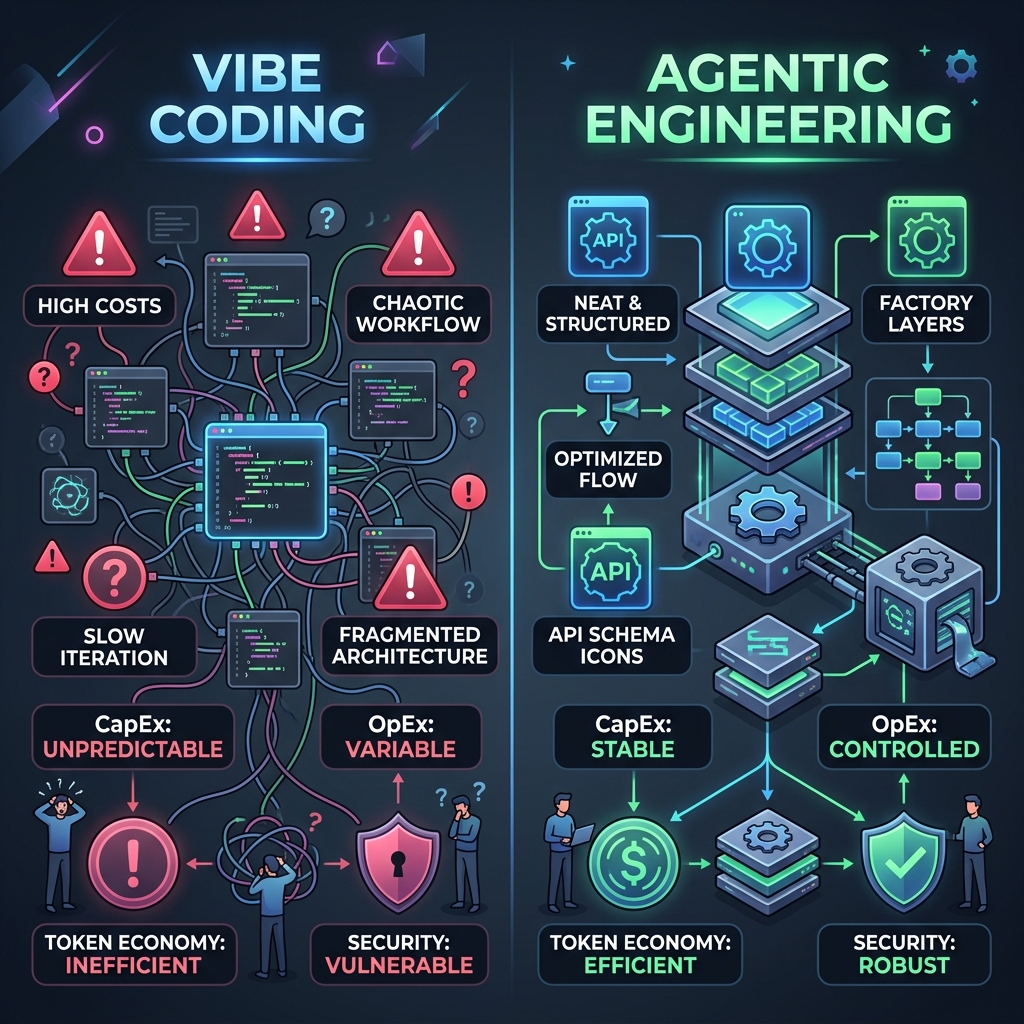
As AI agents become core to how we build software, we are witnessing a fundamental shift in the Software Development Life Cycle (SDLC): moving away from writing code syntax manually, to specifying system intent. But how we orchestrate these agents determines the ultimate cost and quality of our products. In day 1 of the AI Agents Intensive Course, the contrast between "Vibe Coding" and "Agentic Engineering" became crystal clear.
🔴 Vibe Coding (Exploratory Prompting) is highly accessible. It has negligible upfront costs (CapEx) since you can prompt an LLM to generate code on the fly. However, it builds a massive, compounding operational debt (OpEx). Unstructured prompts lead to a high token burn rate, spaghetti code that requires heavy human reverse-engineering, and security gaps due to the lack of an automated evaluation harness.
🟢 Agentic Engineering (Production-Grade Architecture) flips this model. It requires a deliberate, upfront investment of engineering time (CapEx)—designing API schemas, writing deterministic test suites, and structuring context. By treating context as a financial lever (e.g., using dense, high-signal instructions like an AGENTS.md file) and routing simple tasks to smaller, cheaper models (Model Routing), you dramatically drive down the ongoing operational token costs (OpEx) while keeping output quality peak and secure.
Which development paradigm is your team currently prioritizing as you adopt AI coding tools? Let's discuss in the comments! 👇
#AIAgents #SoftwareDevelopment #GenerativeAI #VibeCoding #AgenticEngineering #ProductEngineering